Contact Us

For NRI Customers
(To Buy a Policy)


(If you're our existing customer)

For Online Policy Purchase
(New and Ongoing Applications)
Branch Locator

For Existing Customers
(Issued Policy)
Fund Performance Check
Login
 Customers

 Employees
 Partner



Quick links
- Term Insurance Claim Settlement Ratio
- What is Term Insurance CSR?
- Understanding Term Insurance Claim Settlement Ratio with a Numerical Example
- How Is Term Insurance Claim Settlement Ratio Calculated?
- What is Considered a Good Claim Settlement Ratio for Term Insurance?
- Understanding Term Insurance Claim Settlement Ratio
- Claims Settlement Ratio of HDFC Life Insurance for the past 5 years
- Different Types of Life Insurance Claims You Should Know
- Why is Term Insurance Claim Settlement Ratio Important for Policyholders?
- Why Claim Settlement Ratio Matters When Buying Term Insurance
- Key Factors That Affect the Term Insurance Claim Settlement Ratio of a Company
- Calculate Your Term Insurance Premium
- How To Get Your Claim To Settle Smoothly
- Hassle Free Claim Settlement
- What are the 3 Convenient Modes to Intimate a Claim?
- 3 Simple Steps to Intimate Your Claim Online or Offline
- Why Our Claim Settlement Process is Unique in the Industry
- Documents required for claims
- Key Considerations While Checking the Best Claim Settlement Ratio
- Common Reasons Why Life Insurance Claims Get Rejected
- How to select a company in India with the best claim settlement ratio?
- Choosing the Right Sum Assured for Term Insurance
- Conclusion
- FAQs on Term Insurance Claim Settlement Ratio
- Customer Testimonials
- Popular Searches


Term Insurance Claim Settlement Ratio
The Claim Settlement Ratio (CSR) is the percentage of life insurance claims an insurer settles out of the total claims received in a financial year. ...Read More
1 Crore Term Insurance@ Rs.19/day***
Claim Settlements Made Easy: Choose HDFC Life for Quick Settlements!
-

Return of Premium (ROP) Option^
-

Individual Death Claim Settlement Ratio of 99.72%##
-

₹5 lakh instant payout on claim intimation36
-

Special Rates for Salaried & women19
-

0% GST on Premiums#^#
-

Premium Break Benefit35 for up to 12 months
 :1800-266-9777


 Francis Rodrigues
Francis Rodrigues has a decade long experience in the insurance sector, and as SVP, E-Commerce and Digital Marketing, HDFC Life, manages the online sales channel, as well as digital and performance marketing. He has had hands-on experience in setting up sales channels and functional teams from scratch over a career spanning 2 decades.

 Written By:
What is the Term Insurance Claim Settlement Ratio?





Claim Settlement Ratio (CSR) is the % of insurance claims an insurer settles out of the total claims received in a financial year. A higher CSR indicates the insurer’s reliability and credibility, ensuring that policyholders can trust them to settle claims on time.
If a life insurance company has a high claim settlement ratio, it is more likely to honour claims filed by the beneficiaries of a term insurance policy. This ratio reflects the insurer’s trustworthiness and quality of service. The Insurance Regulatory and Development Authority of India (IRDAI) publishes the claim settlement ratios of life insurance companies in its Annual Reports, which can be accessed on its official website.
Understanding Term Insurance Claim Settlement Ratio with a Numerical Example
Claim settlement ratios (CSRs) are published annually and vary by financial year, so it is important to view them in the right context before comparing insurers. The latest available data is for FY 2025–26, which reflects claims settled during that period.
According to IRDAI data, the overall life insurance industry recorded an individual death claim settlement ratio of 98.45%, while the overall CSR stood at 98.64%. Insurers such as HDFC Life reported the best claim settlement ratio in life insurance of 99.72%##.
While CSRs help indicate an insurer’s claim-handling efficiency, they need to consider factors like claim volume, policy terms, and service quality to buy the best term life insurance policy. However, these must not be considered as the sole decision metric when comparing term plans with other options such as a whole life insurance policy.
Moreover, comparing claim settlement ratios across multiple years offers better insight into an insurer’s consistency than a single-year figure. A sustained high CSR reflects stable underwriting and efficient claim handling. Policyholders should also review claim volumes and assess CSR alongside coverage features, exclusions, and service quality for balanced decision-making.
How Is Term Insurance Claim Settlement Ratio Calculated?
Calculating the claim settlement ratio is straightforward. Here's a simple formula you can use:
Claim Settlement Ratio (CSR) = (Number of Claims Settled / Number of Claims Received) × 100
For example:
Imagine a life insurance company receives 1,000 insurance claims over the year and manages to pay out on 996 of them. To find out how well they’re doing, you can use this formula:
Claim Settlement Ratio = (Claims Settled ÷ Total Claims) × 100
Here, it would be:
Claim Settlement Ratio = (997 ÷ 1,000) × 100 = 99.7%
So, the company successfully pays out on 99.7% of the claims it gets.
What is Considered a Good Claim Settlement Ratio for Term Insurance?
For a provider of a term life insurance plan, a claim settlement ratio of 90% or above is considered good. This is so because 90 percent indicates that the insurance provider has successfully settled 90 out of 100 claims during the financial year.
The claim settlement ratio keeps on changing each year, depending on the number of claims the insurer has successfully settled. If an insurer consistently settles over 95% of claims, it shows strong financial reliability and gives buyers confidence. HDFC Life has a claim settlement ratio of 99.72% for FY 2025-2026 with it, your nominees are assured of minimum hassles and fast claim processing.
However, before selecting an insurance policy, it is necessary to consider other factors including the turnaround time of claims, online review of the insurer, sum assured offered and premium amount.
Understanding Term Insurance Claim Settlement Ratio
Claim Settlement Ratio reflects an insurer’s reliability and claims record. Being aware of how it’s updated, what affects it, and its consistency helps policyholders choose prudently.
Annual Publication of Term Insurance Claim Settlement Ratios
The Insurance Regulatory and Development Authority of India (IRDAI) publishes the annual claim settlement ratio of all life insurance providers in India. HDFC Life has a claim settlement ratio of 99.72%## over the fiscal year 2025-2026.
During the fiscal year 2024-25, the claim settlement ratio of HDFC Life Insurance was 99.68%. This percentage is computed based on individual claims over total individual claims during the financial year.
By clubbing a consistently robust claim settlement record with efforts to raise awareness regarding the significance of adequate coverage, HDFC Life empowers individuals to make well-informed financial decisions and secure their family's future with utter confidence.
Importance of Full Disclosure in Claim Settlements for Term Insurance
As any form of 'misstatement' or 'non-disclosure' of facts can lead to your claim getting rejected upon investigation, it is crucial to have full disclosure in the case of term insurance plans. A full disclosure helps to get your claim settled fast and also guarantees the tax benefits of term insurance. Firstly, non-disclosure refers to the scenario when a fact that directly affects the insurance policy's issuance turns out not to be disclosed in the proposal.
As far as misstatement is concerned, it refers to the situation in which there has been withholding of information, or incorrect information has been provided while answering questions in the policy's proposal form. Both scenarios emphasise the importance of correct disclosure for your insurance policy's claim acceptance.
Significance of a Stable Term Insurance Claim Settlement Ratio
IRDAI's Annual Report publishes claim settlement ratios for all life insurance companies. The claim settlement ratio calculation is done based on the total volume of settled claims. At HDFC Life, we have maintained a consistency in claim settlement ratio over the last five years. By now, our ratio is holding a prominent figure in the entire industry.
Claims Settlement Ratio of HDFC Life Insurance for the past 5 years
The claim settlement ratio is a representation of the credibility and integrity of an insurance company and is an important consideration before choosing an insurance provider. Here is the 5-year claim settlement ratio of HDFC Life Insurance.
Sr No |
Financial Year |
Claim Settlement Ratio |
1 |
FY 2025-26 |
99.72% |
2 |
FY 2024-25 |
99.68% |
3 |
FY 2023-24 |
99.50% |
4 |
FY 2022-23 |
99.30% |
5 |
FY 2021-22 |
98.70% |
6 |
FY 2020-21 |
98% |
7 |
FY 2019-20 |
99.10% |
The consistently high claim ratio indicates HDFC Life’s commitment towards its policyholders.
Different Types of Life Insurance Claims You Should Know
There are two main types of insurance claims — Maturity claims and death claims. Read on to understand these in detail in order to make the right choice of insurance.

Maturity Claims
Maturity claims can be received once your policy matures. This amount however can be fixed or market-linked, depending on the type of your policy. Several life insurance policies such as retirement plans, ULIPs, savings plans, and endowment plans offer attractive maturity benefits. At the end of your policy tenure, you can get a lump sum amount after submitting all necessary documents as required by the insurance company.

Death Claims
Death claims are paid out if the policyholder dies during the policy term. It is paid to the policyholder's nominee either as a regular income or a lump sum as chosen when buying the policy. However, the nominee must produce all necessary documents such as a doctor's certificate, proof of death, death certificate and more.
Death benefit claims ensure that the policyholder’s family is capable of sustaining themselves financially in your absence.
Type of Claim |
Documents Required |
Natural Death Claim |
The medical cause of death certificate Medical records and associated documents |
Unnatural Death Claim (Accidental Death / Suicide / Murder) |
Post mortem report First Information Report Panchnama Police inquest report Annuity claim documents |
Natural Calamities / Disaster Claims |
Death certificate issued by the government or local municipality authority Death claim form (including NEFT) Claimant’s PAN card Claimant’s address proof Original policy document Bank passbook or cancelled cheque |
Critical Illness Claim |
Critical illness claim form Medical records (current & past) for instance, hospital records Diagnostic tests reports |
Why is Term Insurance Claim Settlement Ratio Important for Policyholders?
When purchasing a life insurance policy, you might compare features like the sum assured, premium or even customer reviews. But one factor that thoroughly stands out is the claim settlement ratio (CSR). It shows how reliable an insurer is when it comes to paying claims. Zeroing in on an insurer with a high CSR gives you confidence that your loved ones will receive the promised support without unnecessary hurdles.
Here are the benefits of selecting a life insurance provider with a strong claim settlement ratio:
1
1
Assures Financial Security
Life insurance acts as a safety net for a family, especially when the policyholder is the main source of income. A high claim settlement ratio strengthens this assurance by assuring the claim amount will reach the nominee without any unnecessary delays or complexities.
This timely payout can assist the family in covering essential expenses such as home loan repayments, children's education, daily living costs, and even long-term goals. A consistently high CSR is proof of the insurer's reliability, ensuring that financial protection is delivered when the family requires it the most.
...Read More
2
2
Depicts the Insurer’s Reliability
A high claim settlement ratio reflects an insurer's consistent track record of honouring valid claims. Since CSR is a publicly available metric, it gives policyholders a clear way to judge how dependable an insurer is when it truly matters.
Insurers with strong CSR figures over several years show great stability and a customer-first approach, settling claims quickly and fairly. This consistency builds confidence, reassuring policyholders that the insurer will stand by its assurance of financial protection, providing mental peace over the long term.
...Read More
3
3
Co-operation from the Insurer
A high claim settlement ratio also signals an insurer’s willingness to cooperate with beneficiaries during difficult times. It shows intent to honour genuine claims promptly and in a transparent manner without burdening grieving families with avoidable hurdles.
This assurance lowers emotional stress and assists families in feeling supported, knowing their claim won’t be rejected for minor technicalities. For buyers, it’s a valuable tip, i.e., always check the claim settlement ratio before purchasing a plan, as it reflects the insurer’s commitment to providing timely financial support when it’s needed the most.
...Read More
4
4
Indicates Support During the Claims Process
A high claim settlement ratio doesn’t just mean claims are approved; it also reflects the efficiency and support behind the process. Insurers with strong CSR figures usually have streamlined systems, trained staff, and responsive claim assistance teams.
This means nominees are guided properly, documentation issues are resolved quickly, and claims are processed without unnecessary delays. Such support lowers the burden on family members in the course of tough times and ensures a smoother experience in totality.
As a practical move, checking out the CSR can assist in identifying insurers that provide both reliability and compassionate support during the claims journey.
...Read More
Why Claim Settlement Ratio Matters When Buying Term Insurance
Claim settlement ratio (CSR) is one of the most practical metrics to evaluate how reliably a term insurance provider supports families at the time of a claim. For instance, to buy a 5 crore term insurance, you need to consider many factors apart from the CSR.
Here are the factors to consider before buying a term insurance plan:
01
Indicates Insurer Reliability
A high CSR reflects that the insurer consistently honours most claims received, helping buyers judge the company’s credibility and trustworthiness over time. With the highest claim settlement ratio in life insurance, you get the assurance that the insurance provider will repay your claim.
02
Ensures Timely Financial Support
Insurers with strong CSRs are more likely to provide prompt payouts. This ensures beneficiaries receive financial support when they need it most after buying a term insurance with return of premium.
03
Reduces Stress During Claims
Higher CSRs usually mean fewer claim rejections and smoother claim processes. Therefore, to lower emotional and administrative burden on families, look for the best life insurance claim settlement ratio.
04
True Test of a Term Plan
While premiums and features matter, the benefits of term plan prove its real value through reliable claim settlement.
Key Factors That Affect the Term Insurance Claim Settlement Ratio of a Company
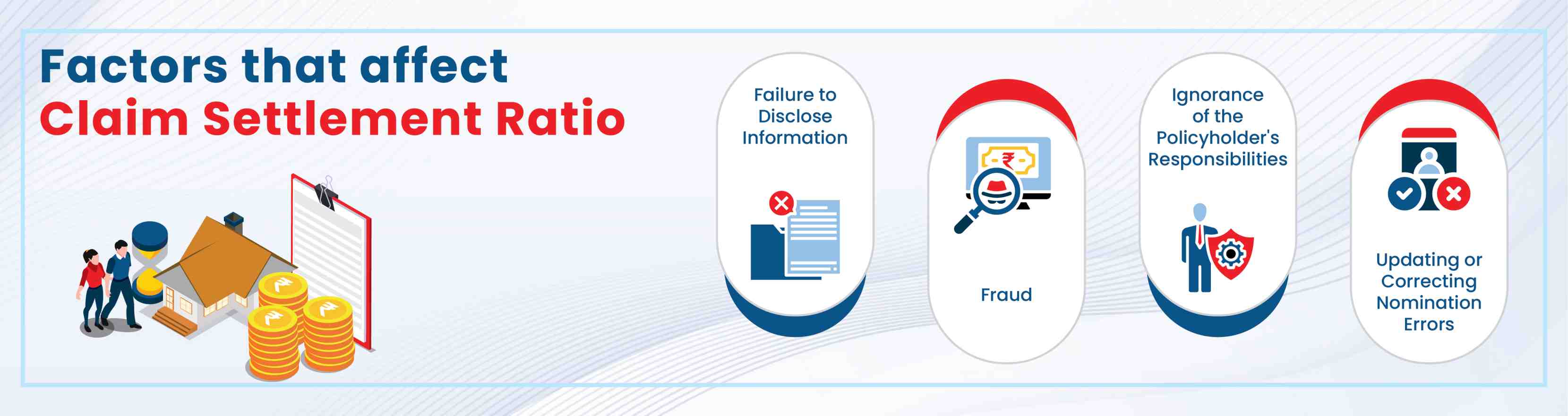
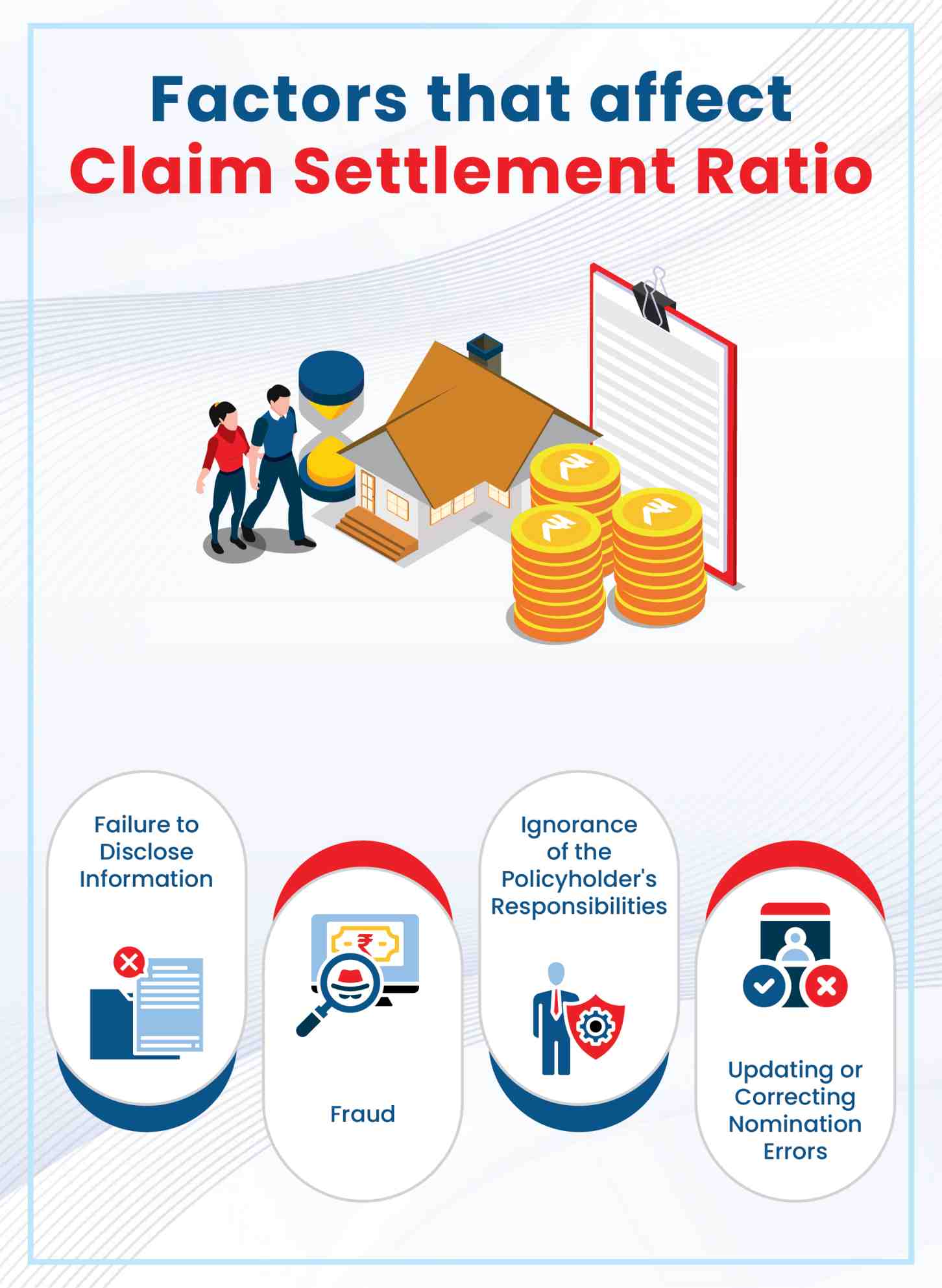
The following factors affect the term insurance claim settlement ratio:
1
1
Failure to Disclose Information
Suppression of information and any missing details can lead to claim rejections. Insurance companies rely on claim settlement documentation to assess the validity of the claims. Withholding information that impacts policy issuance decisions like existing medical conditions, family medical history, etc., will be viewed seriously during the claim settlement process. It may enhance the claim processing time or result in rejection which eventually lowers the claim settlement ratio.
...Read More
2
2
Fraud
If policyholders withhold information intentionally to cheat the insurer, it is construed as fraud. During the claim settlement process, if the insurance company suspects the genuineness of the claim, they may reject the claim. This will reduce the claim settlement percentage.
...Read More
3
3
Ignorance of the Policyholder's Responsibilities
The policyholder should read between the lines to understand the terms and conditions mentioned in the policy and comply with them. Otherwise, it will impact the claim settlement ratio. Some of the responsibilities of the policyholder are paying premiums regularly and providing accurate and complete information while filing claims. Failing to adhere to these obligations will result in claim rejection.
...Read More
4
4
Updating or Correcting Nomination Errors
Updating or correcting nomination errors is of prime importance. Failing which the insurance company will have a difficult time identifying the legal beneficiary. In case of more than one party claiming to be a genuine nominee, the claim will not be settled till the dispute is resolved.
...Read More
Calculate Your Term Insurance Premium
With so many considerations, let us help you to make easy decisions for your life insurance needs
How To Get Your Claim To Settle Smoothly?
Insurers typically process claim payouts for different plans, such as term insurance for the self-employed, within 30 days if all required documents are complete and accurate. If an investigation is required, insurers may take longer, but 120 days from the date of claim intimation is the maximum timeline they allow.
Insurers are more likely to provide faster payouts when the policy has been in force for 3 years or more, all premiums are paid, and the cause of death is non-suspicious. Delays in claim filing or incomplete documentation can extend the payout timeline. A low claim settlement ratio indicates this.
Understanding your policy:
Knowing exactly what your insurance policy covers, along with its exclusions, is the first step toward a smooth claim process. Reading the terms and conditions in advance helps avoid misunderstandings and unexpected rejections during claim settlement.
Maintain Transparency:
Always provide honest and accurate information to the insurer. Any mismatch in details, whether related to health history, cause of loss, or documents submitted, can delay processing or lead to disputes.
Timely premium payment:
Ensuring that premiums are paid on time keeps the policy active. Lapsed or irregular payments can complicate claims and may require additional verification, extending settlement timelines.
Prepare documents in advance:
Organise all relevant documents such as policy papers, medical records, police reports, and claim forms beforehand. Complete and accurate documentation reduces back-and-forth communication and speeds up assessment.
Prompt notification:
Inform the insurer about the claim as soon as possible. Delayed intimation can raise queries and slow down verification, especially in time-sensitive cases.
Maintain contact:
Regular follow-ups with the insurer help track claim progress. Respond promptly to requests for clarification to prevent unnecessary delays.
Seek professional assistance:
If the process feels complex, consider seeking guidance from insurance advisors or support teams to ensure smoother claim resolution.
Why is HDFC Life Claim Settlement easy and Hassle-Free?
HDFC Life Insurance has an easy and hassle-free claim settlement process.It is noteworthy that the HDFC Life Claim Settlement Ratio set a remarkable benchmark of 99.72% for FY 2025-2026. The claim can be lodged in the branch of the company as well as online whereby the policyholders can conveniently lodge their claims and solve out the queries if any.
Apart from such hassle-free and faster claim settlement, HDFC Life also provides for 1-day claim settlement. Here, the policyholder can receive the claim settlement amount within 24 hours of lodging the claim and submission of documents. Following are the conditions subject to which the policyholders can receive claim settlement within 24 hours:
- The policy should have been purchased online
- The insurance claim should not require field investigation to be undertaken
- The cumulative claim amount should not exceed Rs, 2 crores2
- All the claim documents shall be submitted by 3 pm on a working day.
HDFC Life holds complete accountability and responsibility to settle the claim within 24 hours on working days. In case the claim does not get settled, then HDFC Life will pay interest at the rate of 2% per annum above the bank rate for each additional day that the claim gets delayed.
What are the 3 Convenient Modes to Intimate a Claim?
HDFC Life provides three different modes for claim intimation. These are:
1. Online submission of claims
2. Whatsapp users can simply scan the QR code or directly message ‘Death Claim’ on +91 82918 90569 in order to begin the process.

3. You can physically visit the branch for claim intimation with the claim form. The claim form can be downloaded from https://www.hdfclife.com/claims
3 Simple Steps to Intimate Your Claim Online or Offline


Online Claim Intimation
Online claim lodging is convenient, especially for the tech savvy people. It relieves them from going through the hassle of physically visiting the HDFC Life along with physical documents. It offers faster, seamless, paperless, and convenience in lodging the claim. If you wish to lodge the claim online, then follow the below-mentioned steps:
Step-1: Verify the Policy Details
You need to verify your policy details before lodging the claim. Through this, you can provide the necessary information from your policy viz. claim information, information about the claimant, information about the life insured, contact information of the claimant, etc.
Step-2: Submit the Details of Life Assured
The next step is to submit the details of the life assured including ID proofs, medical certificates, discharge receipt, and medical expense documents.
Step-3: Submit the Details of the Nominees
The details of the nominee as required in the claim settlement process shall be submitted.

Offline Claim Intimation
In case you find online claim lodging inconvenient and an offline route is more preferable to you, then you can physically visit any one of our branches. Just follow the below mentioned steps:
Step-1: Submit the Claim Form
You can download the claim form from the website or visit a branch to acquire the same. You must fill in the necessary details before submitting the form. In case you require assistance, you can contact a representative at your nearest branch.
Step-2: Collect all the Required Supporting Claim Documents
Once you fill up the form, submit all the necessary supporting claim documents to the branch representative. This includes identity proofs of the life assured, discharge certificates, medical vouchers, medical reports, and other necessary documents.
Step-3: Submit Claim Form and Supporting Documents
Once the above two steps are completed, you can submit the claim form and supporting documents to our branch. To locate the branch in your city, you can use the branch locator from our website. By entering the state and city, the locator will show you the branches located in your city along with the address and office timings.
Why Our Claim Settlement Process is Unique in the Industry
A high claim settlement ratio means a high rate of settling the received claims. Thus, the insurance company appears trustworthy to the insured person. HDFC Life’s claim settlement process is unique as we ensure a hassle-free claim filing process and immediate fulfilment of requests. Here are some of its features:

Ease
HDFC's Claim Centre provides all the necessary information. In your absence, your nominee can choose either to download the claim form from the website or visit the nearest branch office to file a claim.

Speed
You can claim for your eligible amount under ClaimSecure maintaining the following conditions:
a) You can avail 1-day claim settlement exclusively for all online purchased policies.
b) Cumulative claim amount applicable for all policies up to Rs. 2 crore.
c) There is no need for a field investigation for the claim.
d) Submit all the necessary documents at any nearest office from Monday to Friday before 3 PM. Any document submission after 3 PM will be considered on the next business day.
e) HDFC Life offers interest on your amount death claim amount if there is a delay beyond one working day.

Appointment of Dedicated Officers
On the very next day of claim submission, a dedicated Claims Relationship Officer (CRO) is appointed to provide any personalised services. Having a CRO is very helpful during the settlement of a death claim. The nominee gets assistance and can avail the benefits of insurance claims on time.

Trust
HDFC Life has a claim settlement ratio of 99.72% over the fiscal year 2025-2026.This is by far the highest number that HDFC Life Insurance has achieved to date when compared with previous years.

Support
The customer support services provide constant and speedy support to all queries and grievances of customers. They are ready to serve the customers anytime and anywhere they need.
Step-by-Step Guide to File Term Insurance Claim

Documents Required for Claim Settlement
Claim settlement involves the submission of certain documents in order for the company to verify the details of the claim. Mandatory Documents required for claims:
Death claim form (including NEFT)
Death certificate issued by the government or local municipality authority
Original policy document, (where applicable)
Claimant’s PAN details
Claimant’s ID proof
Claimant’s address proof
Personalized cancelled cheque or Bank passbook(Printed account number, name of the account holder and IFSC code)
Based on the type of claim, additional documents required as mentioned below:
Key Considerations While Checking the Best Claim Settlement Ratio for Term Insurance
The following are the key considerations you should consider while checking the life insurance claim settlement ratio:
1
1
Keeping Documents Updated and Accessible
Delays in claim settlement often happen due to missing or outdated documents like ID proof, address proof, medical certificates, or the policy bond itself. To avoid this, policyholders should review and update these documents regularly with the insurer.
Store them safely, but ensure family members or nominees can access them easily. This small step can prevent claim rejections or unnecessary processing delays.
...Read More
2
2
Informing the Nominee About the Policy
Many claims remain unfiled simply because nominees were unaware of the policy. It’s important to inform them about the insurer’s name, policy details, and the claim process.
Share both physical and digital copies of essential documents and, if possible, prepare a simple step-by-step guide to help them file the claim smoothly, especially if they are unfamiliar with insurance procedures.
...Read More
Common Reasons Why Life Insurance Claims Get Rejected
Life insurance is meant to provide mental peace. But some claims get rejected due to avoidable mistakes. Being aware of the reasons for rejection can assist policyholders in taking timely corrective measures and making sure their families do not witness financial difficulties later on.
01
Wrong Information
Providing accurate info is crucial at every stage, from policy application to claim filing. Common mistakes are incorrect name, age or nominee details that do not match documents like Aadhaar or PAN. Even small spelling errors or data mismatches may result in delays or blocked claims.
Vague nominee details, such as using just the first name, may also create disputes. In addition, hiding medical past records or lifestyle habits such as smoking or alcohol use can invalidate claims. Consistent documentation ensures smoother claim settlement.
02
Premiums Not Paid
One of the basic reasons for claim rejection is non-payment or irregular payment of premiums. A life insurance policy stays valid only if premiums are paid on time. Insurers generally provide a grace period of between 15 and 30 days (based on payment frequency) to make pending payments.
If this deadline is missed, then the policy lapses. Though revival options prevail, they must be used within the insurer’s timelines. Policies that remain lapsed cannot honour claims. Paying off premiums on a regular basis ensures continuous cover and smooth settlement.
03
Policy that Has Lapsed
A policy lapses when the premium is not paid on time, even after the grace period expires. Once lapsed, the policy becomes inactive, and the insurer is not liable to settle claims made during this period. If the insured expires while the policy is lapsed, the nominee will not receive any death benefit.
Policies may be revived, though insurers might require fresh medical checks or additional charges. Keeping the insurance policy active by paying premiums on time is crucial to safeguard the financial future of the family.
04
Medical Information
Disclosing medical as well as lifestyle details is a must when purchasing life insurance and at the time of reviving the policy. This may include chronic illnesses, previous surgeries, hereditary conditions, smoking or alcohol consumption and high-risk activities.
Insurers make use of this info to assess risk and set the correct premium. If any undisclosed issue is discovered in the course of claim evaluation, then the insurer has the right to reject the claim. While full disclosure may increase premiums slightly, it strengthens claim validity as well as builds trust, ensuring a smoother settlement for dependents.
Undisclosed Hazardous Occupation or Hobby
Insurers also assess risk based on the policyholder’s occupation as well as hobbies. High-risk jobs like mining, aviation or firefighting, and hobbies such as skydiving, mountaineering or deep-sea diving must be disclosed upfront.
If omitted or misrepresented, then claims might be rejected later on. Honest disclosure permits the insurer to examine risk correctly and price the policy fairly, ensuring your family receives the claim amount without complications.
Claims Filed After Policy Exclusion Triggers
Every life insurance policy lists certain exclusions (situations in which claims are not payable). Common exclusions are suicide within the first 12 months, death due to illegal activity or war-related deaths.
If the insured’s death falls under these exclusions, the claim will be legally denied even if premiums were paid. To avoid surprises, policyholders should carefully review the exclusions section at the time of purchase and explain them clearly to nominees.
How to select a company in India with the best term insurance claim settlement ratio?
Claim Settlement Ratio
Use IRDAI Annual Report Data
Examine the Claim Volume
Check the Claim Settlement Time
Riders
Read Customer Reviews
Customer Support
The claim settlement ratio is an important factor when selecting an insurance company in India, as it reflects the insurer’s ability to settle claims efficiently. It represents the percentage of claims settled against the total claims received in a financial year. For example, a 98% claim settlement ratio meassns the insurer settled 98 out of every 100 claims filed.
However, customers should also evaluate policy coverage, exclusions, and customer support. Comparing claim settlement ratios across insurers before purchasing a policy can help users make a more informed, reliable choice.
The Regulatory publishes annual reports with official data on insurance companies. These reports provide valuable information about claim settlement ratios, the number of claims settled, and operational performance. Comparing this data across insurers can help customers identify companies with consistent claim performance and financial stability.
Claim volume reflects the number of claims handled by an insurer. A company that successfully manages a large volume of claims may have stronger infrastructure and greater experience in claim processing. It is advisable to evaluate both claim volume and claim settlement ratio together for a balanced assessment.
Claim settlement time refers to how quickly an insurer processes and settles claims. Faster claim settlement reduces stress during emergencies and indicates efficient customer service. Customers should review average settlement timelines before selecting an insurer.
When choosing an insurer with the best claim settlement ratio in India, also check the available riders. Riders^^ like critical illness, accidental death, or waiver of premium can be added to customise coverage as per individual needs. A high claim settlement ratio combined with useful rider options ensures better financial protection and policy flexibility.
Customer reviews can provide practical insights into an insurer’s claim process, transparency, and service quality. Reading both positive and negative reviews helps create a balanced understanding. Authentic reviews can often be found on insurance comparison websites, app stores, and consumer forums.
Strong customer support is essential in the insurance industry because policyholders may require urgent assistance during claims or emergencies. Before purchasing a policy, customers can test responsiveness by contacting the insurer through phone, email, or chat support with basic inquiries.
Choosing the Right Sum Assured for Term Insurance
- It is important to consider the financial needs of your family and assess the sum assured. While choosing the sum assured, you should also account for inflation and ensure that the sum assured beats inflation and will be adequate to meet the specific needs of your loved ones. When choosing the right insurance company, the claim settlement ratio should not be the only satisfying factor. You should also look for a service provider who offers high coverage at an affordable premium. For instance, opting for the best term insurance plan for 1 crore can provide substantial financial protection. However, if you're looking for even greater coverage, the best term insurance plan for 2 crore can ensure that your family is well-secured financially. A term insurance calculator can help you estimate the coverage you need.
Conclusion
Claim settlement ratio is an important criterion that every policyholder should look into before buying their policy. Also, the prospective policyholders shall maintain transparency when it comes to an insurance policy because incorrect or false information could lead to rejection of the claim in the future. This defeats the very purpose of the insurance. At the same time, understanding the term insurance meaning helps you see how CSR directly impacts your family’s financial security during unforeseen events. Thus, going with an insurer who has a proven track record for faster and higher claim settlements can help policyholders meet their objectives. With an Insurance Claim Settlement Ratio that is one of the highest in the country, HDFC Life has been consistently protecting the policyholders whenever things went south.
FAQs on Term Insurance Claim Settlement Ratio
1
What is the meaning of the term insurance claim settlement ratio?
The claim settlement ratio (CSR) is the percentage of claims an insurer settles out of the total claims received in a financial year. It shows how reliable the insurer is in honouring its promise of paying out claims.
2
What is considered a good claim settlement ratio?
A claim settlement ratio (CSR) reflects how efficiently and reliably an insurer honours policyholders’ claims. A CSR of 90% or above is generally considered strong in today’s market, signalling that out of every 100 claims received, at least 90 have been paid. For instance, a 95% CSR means that 95 out of 100 claims were successfully settled.
A consistently high CSR inspires policyholder confidence and indicates an insurer’s sound financial health, transparent processes and commitment to settling claims without unnecessary delays or complications. However, the figure can fluctuate from year to year based on the number and nature of claims.
For example, HDFC Life reported a 99.72%## CSR in FY 2025–26, demonstrating excellent performance, though the ratio may vary in subsequent financial years.
3
What is the formula for the claim’s ratio?
The formula for computing CSR is:
(Number of claims settled ÷ Overall number of claims received) × 100
For instance, if an insurer gets 1,000 claims in a year and settles 980, the CSR will be 98%.
4
Does the size of the claim (small vs. large) affect the claim settlement ratio?
Yes, the size of any claim can have an impact on the claim settlement ratio. The claim settlement ratio represents the percentage of claims that an insurer has successfully settled, based on the total number of claims. It also focuses on the monetary value of those claims.
Large claims often undergo more rigorous documentation and a long process to validate their legitimacy and ensure adherence to the policy terms. However, smaller claims may experience a faster process owing to simpler verification and less documentation.
Large claims can be rejected or delayed, resulting in a lower actual settlement amount. However, you may show high claim settlement ratios by settling small-value claims.
5
How do you calculate the claim settlement ratio?
The claim settlement ratio is calculated by dividing the total settled claims by the total received claims volume.
6
Why is proper disclosure critical for a better claim settlement ratio?
Improper disclosure or non-disclosure means failing to reveal any fact that is creating an impact on the policy issuance decision in the proposal. Non-disclosure also leads to denial of the claim. Hence, it is recommended to provide proper disclosure to create a positive effect on the claim settlement ratio.
7
What is the timeframe for reporting a claim?
There is no particular timeframe for reporting a claim. However, reporting a claim as soon as possible helps in faster processing. For disability claims, you need to report within 120 days from the date of disability. Moreover, it is essential to report the claim within 60 days for any surgery or critical illness.
8
Who qualifies to receive the claim benefit?
The nominee registered in the policy document is eligible to receive the claim benefit. If no nominee is mentioned, the legal heir (such as spouse, children, or parents) may have to provide succession documents to receive the payout.
9
What makes the claim settlement ratio important?
A claim settlement ratio shows an insurance company's ability to pay the claimed sum assured to you or the nominee. In case an insurer has a high claim settlement ratio, it indicates that there is less likelihood of default on payment of the sum assured. On the other hand, a low claim settlement ratio (CSR) indicates a higher chance of your claim getting rejected.
10
How do you check the claim settlement ratio?
The claim settlement ratio of all life insurers in India is published yearly in the IRDAI Annual Report. You can even check out CSR figures directly on the insurer’s website or trusted financial portals.
11
Is a higher claim ratio better?
Yes. A higher claim settlement ratio implies the insurer has settled most of the claims received, which reflects greater reliability. For policyholders, this shows a higher probability that their nominees' claims will be honoured without any issues.
12
How reliable are insurance companies in paying claims?
Most life insurance companies in India are reliable, with many maintaining CSRs of over 95% year after year. HDFC Life, for instance, has consistently reported good claim settlement ratios in the industry, reflecting its strong commitment to honouring valid claims as well as providing financial protection to families during difficult times.
13
What is the 3-year rule in life insurance?
The 3-year rule in life insurance states that once a policy has completed 3 years from the date of the policy, i.e., from the date of issuance of the policy or the date of commencement of risk or the date of revival of the policy or the date of the rider to the policy, whichever is later, the insurers cannot reject claims on any grounds. Defined under Section 45 of the Insurance Act, it protects nominees from arbitrary claim rejections after the initial contestability period ends, thereby improving term trust and certainty for families.
14
Why are term insurance claims rejected?
Insurance companies reject term insurance claims mainly due to non-disclosure of material facts, incorrect information in proposal forms. Insurers may also reject claims if the circumstances of death appear suspicious, documents are incomplete, or policy terms and exclusions are violated during assessment.
15
What factors influence the claim settlement ratio in India?
Claim settlement ratio in India is influenced by disclosure accuracy, policy tenure, premium payment consistency, claim documentation quality, and nominee clarity. Insurer efficiency, fraud detection practices, volume of claims received, and transparency in underwriting also affect outcomes. Better customer communication and faster internal processes usually improve settlement ratios over time, according to insurer disclosures and comparative analysis published annually nationwide.
16
What else should be considered besides the claim settlement ratio when buying term insurance?
Besides the claim settlement ratio, buyers should evaluate premium affordability, policy coverage, exclusions, riders@**, insurer reputation, and customer service quality. Claim processing speed, ease of documentation, digital support, grievance handling, and the insurer’s long-term financial stability also matter. These factors determine overall protection value beyond just numerical ratios, ensuring suitability for individual family needs and financial goals planning.
17
How can I choose the best term insurance company in India based on CSR?
To choose the best term insurance company based on CSR, compare ratios published by IRDAI over multiple years. Prefer insurers with consistently high settlement records, transparent claim processes, and sufficient claim volumes. Cross-check customer reviews, service responsiveness, and policy features. This is to ensure CSR strength aligns with overall reliability for long-term family protection and dependable claims experience in practice.
18
What does a 99% claim settlement ratio mean?
A 99% claim settlement ratio means an insurer settled 99 out of every 100 claims received during a financial year. It indicates strong claim handling efficiency and reliability. However, it does not guarantee approval of every claim and should be assessed with claim volumes and consistency across years, insurers' policies, customer profiles and regulatory disclosures published.
19
What documents are required for term insurance claim settlement?
Documents required for term insurance claim settlement typically include a completed claim form, original policy document, death certificate, nominee identity proof, and address proof. Depending on circumstances, medical records, hospital reports, employer certificates, or police documents may be required. Additional documents may also be required subject to applicable terms and conditions. Accurate submission helps insurers process claims faster, as outlined by insurers' guidelines and communicated during claim initiation through official channels only.
20
How to apply for claims?
To apply for a term insurance claim, the nominee must inform the insurer promptly and submit a duly filled claim form with the required documents. You can initiate claims online, through branch offices, or via customer support. Insurers then verify details, request clarifications if needed, and process settlements within prescribed timelines. This is done to avoid delays and ensure smooth assessment and payout completion.
21
Where can claim forms and official document lists be accessed?
You can access claim forms and official document lists on the insurer's official website under the claims section. They are also available at branch offices or through customer care support. Insurers regularly update these lists to reflect regulatory guidelines and ensure claimants submit correct documentation before claim initiation. This is done to reduce errors, delays, and repeated follow-ups during settlement communication stages.
22
Who is entitled to claim benefits under group insurance policies?
Under group insurance policies, the designated nominee or legal heir of the insured member can claim benefits. Coverage is provided through employers or organisations, and eligibility depends on membership status at the time of death. Claims follow policy terms agreed between insurer and group policyholder, with documentation requirements similar to individual term insurance claims.
Customer Testimonials
-
![G S Ravi]()
very professional and considerate to the claimants with grief. the process was really clean n fast by any standards. very happy the way the claim was received n settled.
G S RaviJuly 01,2023 -
![Sanjay Goyal]()
excellent claim settlement service death claim of Term Insurance policy settlement & payment made 2-3 working days on submission of paper and claim process on with in 2 hours on submission of documents. Excellent service.
Sanjay GoyalJune 30,2023 -
![Thanshika Vijay]()
The claim process is exceptionally good, very quick and clear document process..
thanks a lotThanshika VijayJune 29,2023 -
![Shakuntalarashmi Anilkumarchandel]()
team understood the requirements, worked on the insurance work, provided details and helped me fill forms and with minimal effort and time completed the task. Person with grief had to go through multiple things but team made it easy and approachable. appreciate the work.
Shakuntalarashmi AnilkumarchandelJune 28,2023 -
![Nandita Joutick]()
very humble and respectful service provided by your team member...I am very satisfied and greatful for him.
Nandita JoutickJune 27,2023 -
![Suganya R]()
thank you so much for understanding our needs at this difficult time of ours. the team was very organised and requested all the details promptly. once we furnished the information the process was quick and hassle free.
Suganya RJune 26,2023 -
![Neetu Agarwal]()
Extremely grateful for your fast and timely settlement.My whole family is so grateful to you for the kind concern.
Neetu AgarwalJune 25,2023 -
![Ruchi Gupta]()
you did your work honestly.better understanding with customer.
Ruchi GuptaJune 24,2023 -
![Sheetal Wadkar]()
the service was excellent.. very helpful in this painful situation. i really appreciate HDFC Life.
i have given reference to other my friends.Sheetal WadkarJune 23,2023 -
![Surinder Kaur Manik]()
very fast claim settled in 24 hours.
Surinder Kaur ManikJune 22,2023


HDFC Life
Reviewed by Life Insurance Experts
HDFC LIFE IS A TRUSTED LIFE INSURANCE PARTNER
We at HDFC Life are committed to offer innovative products and services that enable individuals live a ‘Life of Pride’. For over two decades we have been providing life insurance solutions - protection, pension, savings, investment, annuity and health.

Popular Searches
- term insurance
- Term Insurance Calculator
- Investment Plans
- savings plan
- ulip plan
- retirement plans
- health insurance plans
- child insurance plans
- group insurance plans
- saral jeevan bima yojana
- income tax calculator
- bmi calculator
- compound interest calculator
- income tax slab
- Income Tax Return
- benefits of term insurance calculator
- what is term insurance
- why to invest in life insurance
- Ulip vs SIP
- tax planning for salaried employees
- how to choose best child insurance plan
- Retirement Planning
- 1 crore term insurance
- HRA Calculator
- Annuity From NPS
- 2 crore term insurance
- 5 crore term insurance
- 1.5 crore term insurance
- Retirement Calculator
- Pension Calculator
- What is Investment
- Best Investment Plans
- Term Insurance for Housewife
- Money Back Policy
- life Insurance policy
- life Insurance
- Zero Cost Term Insurance
- critical illness insurance
- Whole Life Insurance
- types of life insurance
- types of term insurance
- Benefits of Life Insurance
- Endowment Policy
- Term Insurance for NRI
- Term Insurance for Women
- Term Insurance for Self Employed
- Benefits of Health Insurance
- Health Insurance for Senior Citizens
- Health Insurance for NRI
- Saving Schemes
- Life Insurance for NRI
- Investment Plans for NRI
- features of term insurance
- Best Term Insurance Plan for 1 Crore
- personal accident insurance
- 30 days for non-investigation cases and additional 90 days for investigated cases
- This is subject to claim assessment and if no further investigation is required.
@As per integrated annual report FY25-26, available on www.hdfclife.com. As of May 2026
^ Available under Life & Life Plus plan options
#Provided we have received all the relevant and required documents and no further investigation is required. Claim settlement process would be completed within stipulated timelines once the claim request is approved
##Individual claim settlement ratio by number of policies as per audited annual statistics for FY 25-26
***Online Premium for Life Option for HDFC Life Click 2 Protect Supreme Plus(UIN:101N189V03), Male Life Assured, Non-Smoker, salaried, 20 years of age, Policy term of 25 years, Regular pay, Monthly frequency, inclusive of 15% online discount (applicable only for 1st year premium) & exclusive of taxes and levies as applicable. (Monthly Premium of 573/30=19).
**If a customer is a Salaried individual and has opted for a cover of INR 2 Cr with Limited pay, then the total discounts applicable shall be: 10% +7% = 17% discount on the first year premiums.
~Tax benefits of ₹ 54,600 (₹ 46,800 u/s 80C & ₹ 7,800 u/s 80D) is calculated at highest tax slab rate of 30% on life insurance premium u/s 80C of ₹ 1,50,000 and health premium (Critical illness rider) u/s 80D of ₹ 25,000. Tax benefits are subject to conditions under section 80C, 80D, 10(10D) as per Income Tax Act, 1961. Please consult your tax advisor for more information.
*Online Premium for Life Option, Male Life Assured, Non-Smoker, 20 years of age, Policy term of 40 years, Regular pay, Monthly frequency, exclusive of taxes and levies as applicable
19. HDFC Life Click 2 Protect Supreme Plus(UIN:101N189V03) is a Non-Linked, Non-Participating, Individual, Pure Risk Premium/ Savings Life Insurance Plan. Life Insurance Coverage is available in this product: 10% discount on first year premium would be applicable for only Salaried customers, under Regular Pay & Limited Pay. A 15% discount on the base premium rates will be applicable for female lives.
#^# Individual Life Insurance Policies issued on or subsequent to 22nd, September 2025, shall be exempt from GST under the provisions of the Goods and Services Tax, 2017.
35. Applicable if the policy has completed at least five (5) policy years from the risk commencement date and all the due premiums have been received in full and the policy is in force. If the premium break benefit has been exercised in the last 5 policy years, then the next premium break benefit shall not be allowed. The premium break benefit shall not be available during the last policy year of the premium payment term.
36. Applicable for all in force policies after a waiting period of 1 year. Please refer to policy documents for Terms & Conditions
^^Rider can be added to base product on payment of additional premium. For all details on Riders, kindly refer to the Rider Brochures available on our website.
ARN - ED/05/26/34137